Monday, September 5, 2011

ELECTRIFICATION OF THE KGF MINES - KGF was the first Mining Industry in Asia to get Electricity in 1902

An Excerpt from my Book KOLAR GOLD FIELDS DOWN MEMORY LANE

From the inception of the mines in 1880 until the year 1902 all the machinery in the Kolar Gold Mines were worked by steam power. Feeling the need for captive electric power, The John Taylor and Sons Company prevailed upon the British Government in Mysore to provide Electric power to the Company to meet its huge need for electricity, for running the machines and various other needs. The Cauvery Power Scheme was thus initiated in 1900 by the Mysore Government, under K Seshadri Iyer, the then Diwan of Mysore. The credit however, for the Cauvery Falls Power Works was attributed to Captain Lotbiniere R.E., the then Deputy Chief Engineer of the Mysore Government.

The initiating of the Cauvery Power Scheme has also been recorded in The Karnataka State Gazette, Mandya District as follows:  ‘The Mysore Government decided to investigate the practicality of generating power at Shivanasamudram Falls Site and enlisted the services of Colonel Campbell, the Chief Engineer at Madras for the same with the cooperation of the Madras Government. The Chief Engineer took a very favourable view of the potential of the project. In June 1899, the Deputy Chief Engineer of Mysore, after studying the details of the power installation at the Niagara Falls (in North America), was convinced of the idea of working the machinery at the Kolar Gold Fields with the electricity generated by the Cauvery falls.
The scheme received the hearty support of Seshadri Iyer and Colonel Campbell.  M/S John Taylor & Sons of London, who had the general control on KGF also supported the scheme. The government decided to utilise the head of the falls for hydro-electric power and its transmission for the service of industrial undertaking in the state of Mysore, inclusive of KGF, in 1899 “.
                                                                                          
The first major Hydro Electric Generating Station for commercial operations was thus commissioned in 1889 at Shivasamudram, near Mysore, The longest transmission line, at the highest voltage in the world, was constructed exclusively to meet the power needs of mining operations at Kolar Gold Fields.

The work on the Cauvery Power Works Station at Shivasamudram was completed by the middle of 1902. The 30th of June 1902, was a Red Letter Day in the history of Mysore State and the Kolar Gold Mines. It was on this day, 4000 H.P. of Electric Energy was transmitted from the Cauvery Falls Power Station at Shivasumudram through the longest transmission line to Kolar Gold Fields for the first time. Thus the erstwhile Mysore State, became the first State in India, to establish such a huge Hydro-Electric Plant.


It has been further recorded in the Karnataka Gazetteer that:  quote “The first Hydro-electric power station in Asia was set up when the British Resident General Donald Robertson in Mysore launched the 700 KW Hydroelectric Station which transmitted power to KGF on 30th June 1902”.  Unquote.


KGF was thus supplied with electric power from Shivasamudram in 1902. It was the first time in Asia that electricity was generated and supplied, through a transmission line that was more than 80 miles long. It was the longest transmission line in the world at that time - the second longest was at the Niagara Falls which was only 13 miles long!

Saturday, August 27, 2011

BGML MINING HOSPITAL KGF

THE KGF COMPANY HOSPITAL - An excerpt from my Book KOLAR GOLD FIELDS DOWN MEMORY LANE
 
The John Taylor and Sons Company with the co-operation of the O’Donnell brothers, Dr T J O’Donnell and J D O’Donnell, established a well equipped hospital in 1880, to cater to the medical needs and emergencies of the miners and their families. It was centrally located in Champion Reefs. Dr T J O’Donnell was the first Chief Medical Officer of the Hospital and served as the CMO for more than 25 years.  

The hospital was staffed with eminent British and Indian doctors and British and Anglo-Indian nurses. The hospital wards were named after the erstwhile British bosses such as Gideon Ward, Henry’s Ward, Morgan ward, etc.. Medical Treatment was provided free of cost for the miners and their families. A well maintained Maternity Unit was also later established in a separate wing of the Hospital.

The Mining Hospital slowly gained the distinction of being the best hospital in the whole of the Kolar district. This Mining Company Hospital was later recognized by the Indian Medical Council as a reputed center for the treatment of Occupational Diseases, such as Tuberculosis, Silicosis, etc. This photograph of the Hospital was taken in 1930.

As with all other aspects of KGF, there was a small legend attached to the Mining   Hospital as well. The legend states that the British built a small temple dedicated to the Goddess Mariamma at the side of the Hospital. She was considered to be the Goddess of Small Pox and Chicken Pox as well as other summer heat related diseases such as measles and mumps.

The workers prevailed upon the British owners of the Company to build this small temple near the hospital to appease the Goddess and seek her blessings, so that she wouldn’t get angry at being deprived of curing people without medicines!!! People visiting the hospital would visit the temple and pray to her to look after their family members who were ill in hospital.

Today this Hospital with its once expensive equipment and more than 200 beds has been shut. Most of the medical equipment has been stolen. The hospital wards named after the erstwhile British bosses such as Gideon Ward, Henry’s Ward, Morgan ward, etc., are completely denuded of the beds and furniture and the hospital now resembles a haunted building, and is slowly falling down in parts. Its so sad to think that “This Hospital” which was once the best hospital in the whole Kolar District which saved the lives of so many people has now died.

Wednesday, August 10, 2011

Champion Reefs Workshops KGF established in 1900

The Champion Reefs Workshops were established in 1900 to carry out all the major engineering work of the Champion Reef Mine. This picture shows it in all its glory in its hey days


This photograph taken in the year 2001 shows signs of its neglect when the mines were shut down


The final requeim. The Champion Reefs Workshops in its present neglected and sad state

Thursday, July 28, 2011

KGF CLUB / GYMKHANA CLUB / GOLF CLUB

The KGF Golf / Gymkhana Club was established by the British Mining Company John Taylor and Sons in 1885 with a 12 Hole Golf Course and a Beautiful Victorian Club House. The Club House was equipped with a traditional bar, a library, a ballroom with a sprung floor, snooker and billiard rooms and tennis courts, which were all built and completed in a period of just six months. This Club was the first club to be established in KGF and is ranked as the 4th oldest Golf Club in India. It had its own Polo, Golf and Hockey teams, In those days, the club was totally out of bounds for the Indians, and only the British and Europeans could become members. The Club house and the 12 Hole Golf Course was built in just 6 months by the vast labour force in KGF at that time.

Because of the hilly terrain of KGF, the 12 Hole Golf course was located in a winding treeless landscape. Unlike other Golf courses which have Putting Greens the KGF Golf Club had no Putting Greens. Instead it had ‘Browns’ constructed of river sand in place of greens.

The KGF Club House has a regal Colonial ambience. The old Club house that is more than a century old, was built of stone quarried from the area itself. It had strong dark teak wood doors and windows with solid brass handles, hinges and knobs. These handles and knobs were constantly polished by the club servants in those days and shone like gold. These fittings as well as the sterling silver cutlery and the beautiful crockery with the Club’s emblem were all brought specially from England, when the club was constructed by the British.


The KGF Club also had the distinction of having an exclusive “Ladies Bar” just off the main lounge. The British and European ladies made good use of this lounge and enjoyed their drinks while catching up with the latest news and exchanging gossip with their friends.. The Ladies lounge also had a huge grand piano and the ladies invariably gathered around it singing all the old songs and ballads while one of them played the piano. The club was surrounded by a beautiful garden with well maintained sprawling lawns and flower beds. The serene surroundings with the golf course on the side looked like a picture from an old English Countryside.

The foyer of the club has many deer and bison heads on its walls. There are also a number of framed photographs of all the old Superintendents and Chairmen of the Mines starting with Mr. John Taylor in the lounge of the club. Besides these there are a lot of other photographs as well.


One particular faded sepia print of smiling Britishers standing around an iron bucket on one of the walls of the lounge draws one’s attention. The old Bar man Susairaj was often willing to share the story behind this photograph to anyone who was interested in listening even if it meant repeating the story any number of times.


According to Susairaj’s story, when the KGF Golf Club came into existence, and a new club house was built, and the 12 Hole Golf Course was laid, the Club hosted the first KGF Gymkhana Golf Tournament. However the organizers forgot to arrange for a suitable Trophy for the first Tournament. It was quite an embarrassing moment when it was time to award the winner and there was no trophy to be given. They just improvised by using an old cast iron bucket with the words ‘The Cup’ painted on it. The old picture is of the winning team posing with the trophy of the very first tournament.

Like the rest of KGF, there are visible signs of deterioration in this once prestigious Club. The Bar is not so well stocked now and soft drinks are served in a bottle with a drinking straw and paper napkins. The snacks and short eats that the club was so famous for in the old days have been replaced with small packets of store bought nuts and fries. The mounted Antlers and Horns still adorn the foyer of the club. However, the beautiful garden surrounding the Club has disappeared, the grand Piano in the erstwhile ‘Ladies Bar’ now lies unused and in need of repairs. The brass door knobs and handles no longer shine, the beautiful crockery and cutlery with the Club’s monogram have all disappeared and now replaced with ordinary ones.

The Club still has almost 600 members on the rolls. The members still enjoy their rounds of Golf and visit the Club for a game of Billiards and Snooker and enjoy a drink in the not so well stocked Bar!!!

Wednesday, July 20, 2011

BOY SCOUTS MOVEMENT IN KGF


The Boy Scouts Movement was started in India by the British as early as 1909 in Bangalore but it was open only to British and Foreign Scouts. In 1916, the Indian Boy Scouts Association was founded and was open to all Indians.
In 1929, Mr. V.N. M. Felix, who was a Malaria Inspector, attached to the Sanitary Department, Champion Reefs, founded The 5th Kolar Gold Fields (St. Mary’s) Open Scout Group, that functioned from the Champion Reefs Scout Den until the late 1980s. Scouts from this Den attended many state and national level camps under the leadership of Mr. Felix. Scout meetings were held regularly on Saturday evenings. The Scouts and Guides movement in KGF was quite active under Mr. V.N.M. Felix, who was the Scout Master in KGF. He was a short thin man with a huge white mustache. He wore his khaki shorts and shirt and the Scouts tie, scarf and stockings with pride. Besides, training the young boys to be scouts he also started the Bulbul Movement for the girls. Mr.S. A. Bayley, a British Officer, who was the Chief Cashier and Accountant in Nandidroog mines was the Vice-President, K.G.F. District Scout Association in the 1940s and 50s. His contribution to the growth and popularity of the Scout movement in K.G.F. was significant. In 1946 he was awarded the ‘Silver Elephant’ (which is the highest award in Scouting in India) by the then Chief Scout His Highness The Maharaja of Mysore! The Boy and Cub Scout Movement was active in the K.G.F. School up to the 1950s then went into decline.


In 1962, Mr. Dudley Pinto took over as the Head Master of the School from Mr. Sterling. Incidentally, Mr. Pinto was the Group Leader and District Scout Master at the Southern Railway Mixed High School (English Medium) in Khargpur, West Bengal, where he worked until 1961. In 1966 some students prevailed upon Mr. Pinto to revive the Boy Scouts group in the KGF School. Accordingly, a Scout Group with about 20 boys was formed with Mr. Pinto as Scout Master in KGF School. Mr. Felix and Mr. George Bastian of the St. Mary’s Scout Den, Champion Reefs, were closely associated with the Scout activities of the KGF School.
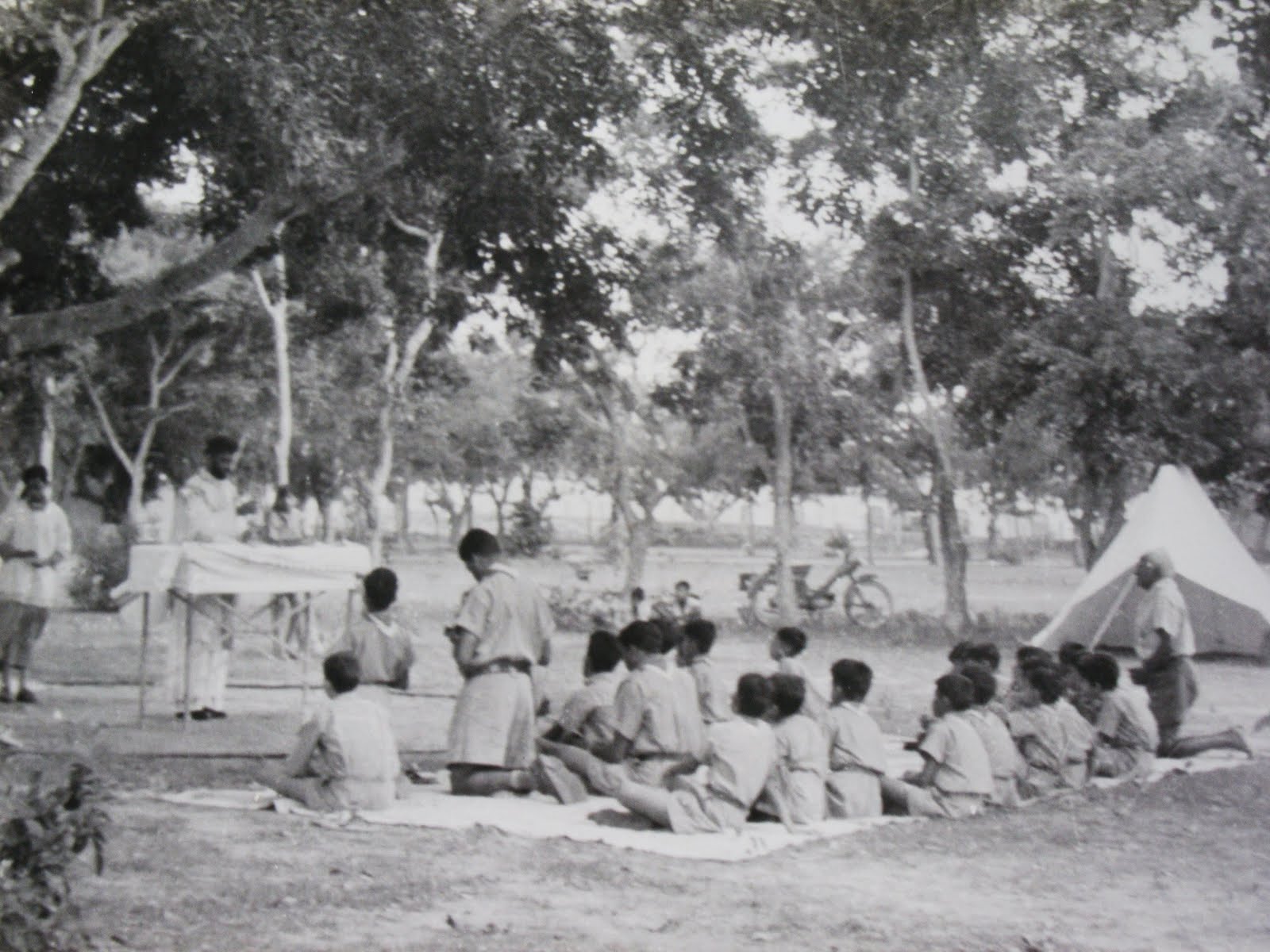
In 1967, Mysore State celebrated the Golden Jubilee of Scouting at the Central training Camp in Doddaballapur in which the Scout group from the school participated. A two day Scout Camp was also conducted by Mr. Felix at Bethamangalam for the scouts of the KGF School. The Scouts movement was quite active for a few more years, but with the departure of Mr. Pinto from K.G.F. School, the Scout Movement was overtaken by the NC


These pictures of the 2 day Scout Camp at Bethamangala in 1967 attended by the Boy Scouts from KGF School were very kindly given to me by Mr Ravindra Kumar who now lives in Chennai when I was bringing out my book on KGF. Thanks Ravi.

THIS IS AN EXCERPT FROM MY BOOK KOLAR GOLD FIELDS DOWN MEMORY LANE.

Sunday, July 10, 2011

Skating Rink , (Nandydroog Mine KGF)

The Skating Rink was diagonally opposite our house and next door to the Nandydroog Club. The Skating Rink was the only big Auditorium or Party Hall in KGF at the time and was the most popular venue for Wedding Receptions, Parties, Get-togethers, School Functions and Concerts, Musical recitals, Meetings, Dances etc. The Christmas Dances, May Queen Balls, Easter Ball, June Rose Balls, The Anglo-Indian Association’s Annual General Meeting and Ball, New Years Eve Ball, Independence Day Ball, The Republic Day celebrations etc, were all held at the Skating Rink.

A function was held there practically every month and it was a famous landmark for all in KGF.

In the olden days this hall was used for Ice Skating and Roller Skating by the British. The floor was as smooth as silk and was an amazing dance floor. Just before a dance, chalk powder would be strewn on the floor to facilitate easy dancing movements for the dancers. Besides being used as a hall for functions and dances, the Skating Rink was also an indoor Shuttle Badminton Court. We would regularly play shuttle here during the holidays.

Sadly, the Skating Rink which stood the ravages of time for well over a hundred years is now in shambles. The inner walls are all crumbling and the false ceiling of Tatty Cane is worn out in several places. However people still continue to hold their functions in it and camouflage the interiors walls with huge coloured Cloth and decorations. It will always remain their ‘dear old Skating Rink’


Saturday, July 9, 2011

A FEATURE ON ME IN THE HINDU - 3rd June 2011

A FEATURE ON ME IN THE HINDU
- The Hindu Life & Style » Metroplus 3rd June 2011
http://www.thehindu.com/life-and-style/metroplus/article2071072.ece?sms_ss=facebook&at_xt=4de87550968c3fe0%2C0


A Passage to Colonial India 
 
Bridget White-Kumar takes Mini Anthikad-Chhibber through the delicately spiced pages of history into a world of memsahibs, cucumber sandwiches, kedgeree and khansama

Stepping into Bridget White-Kumar's house just off the busy Koramangala Ring Road is to step into another world altogether. There are the flowering trees, plants, shrubs, lovebirds all flourishing in a riotous symmetry. The old world charm of the house with its glass showcases, the colourful aquarium with its plump, brilliantly-hued fish is an echo of Bridget's life-long project of preserving the Anglo-Indian legacy through its cuisine.

Having written seven recipe books including the latest, “Vegetarian Delicacies” and a book on Kolar Gold Fields, where she was born — “Kolar Gold Fields – Down Memory Lane – Paeans to lost Glory,” Bridget is doing her bit to see that a way of life does not pass off into the dusty pages of history.

“It all started when my daughter, Kusum, was going to England to study,” says Bridget with a smile. “I wrote her a small recipe book. The original little black book! There were recipes for regular cooking like rice, curries and snacks. When Kusum returned, she said all her friends had enjoyed the food. That Easter, while we were eating the traditional Easter lunch, my daughter said these recipes would die out unless they were recorded. That got me thinking and I set about collecting recipes.”

Collating recipes handed down from her mother and grandmother, Bridget soon had a wealth of information about Anglo-Indian recipes. “I sent the manuscript around and Roli Books showed interest. But it was all taking too much time. I decided to pick out the most famous Anglo-Indian dishes and publish it myself.”

And that is how “The Best of Anglo-Indian Cuisine – A Legacy” was born. “I tempted readers with the picture of classic Anglo Indian dishes — coconut rice, devil chutney and ball curry, on the cover,” Bridget says with a laugh. The book was a super success. The other books followed including “Flavours of the Past” with colonial favourites such as Railway mutton curry.

After her graduation in Kolar, Bridget came to Bangalore to do her B.Ed, which is where she met her husband. “He was my first cooking instructor! He taught me to strain rice. I asked my mother and mother-in-law for recipes. “Since my husband is from Guntur in Andhra Pradesh, known for its fiery cooking, and I am Anglo-Indian, my cooking was a fusion of the two. I started off with simple dishes and then graduated to more complicated recipes. My first big success was the biryani, which was not too bland nor was it too spicy or too rich. I realised ethnic cooking is dying out and needs to be preserved.”

About the legacy of Anglo-Indian food, Bridget says: “Roasts, stews, bakes, sandwiches and white bread, fish and chips, cutlets, croquettes, sausages, bacon, ham, egg variants, puddings, custards, became part of the Anglo-Indian culinary repertoire. The Sunday English breakfast of eggs, bacon and kippers, toast, cheese, butter, jams, and English roast dinners complete with steamed vegetables, roast potatoes, Yorkshire pudding and gravy, English sausages, colloquially known as bangers with mash, became very common in Anglo-Indian homes.” Anglo-Indian cuisine has a strong Scottish influence too. “The bread pudding, treacle pudding, mince and tatties, steak and kidney pie and of course kedgeree (kichdi) are a result of the cross pollination between cultures.”

Anglo-Indian food should not be looked at as a homogenous entity, Bridget says. “The recipes are an amalgamation of the tastes and spices of the region. So the Anglo-Indian cuisine from Bengal will have more sea food and mustard oil while the cuisine from landlocked Kolar would feature more meat.”

Bridget took VRS from Canara Bank after working for 23 years. She says she is busier than before.

She started a blog on KGF “four to five years ago. Every time I visited, I saw the deterioration. I felt the nostalgia and the need to preserve the story of KGF for coming generations”. That is how “Kolar Gold Fields – Down Memory Lane – Paeans to lost Glory” was born. An easy read, the book effortlessly brings to life the world of dances, food and hard work.

As I look through Bridget's collection of recipes, written by her mum and grandmother on little pieces of paper and also flip through this rare, old book, “Original Madras Cookery” published in 1874 written by an anonymous British Resident's wife I am transported to a world of khansamas, mulligatawny soup, bone china tea services and delicately-sliced cucumber and chutney sandwiches. At my back I can hear the insistent hum of Koramangala traffic as it speeds down our very own information highway. It is however nice to sometimes take a break and indulge in some heavy duty Raj nostalgia.

Mini Anthikad-Chhibber

http://www.thehindu.com/life-and-style/metroplus/article2071072.ece?sms_ss=facebook&at_xt=4de87550968c3fe0%2C0

Thursday, June 2, 2011

KGF FIRST GRADE COLLEGE - OORGAUM KGF

Excerpt from my book KOLAR GOLD FIELDS DOWN MEMORY LANE - Paeans to lost glory!!!!


The KGF First Grade College was started in 1962 to cater to the higher educational needs of the predominantly socially challenged communities of KGF comprising mostly of children of the mine workers since they couldn’t afford to send their children to Bangalore or Mysore for their college education.


The Government of Mysore established an Undergraduate College known as the KGF First Grade College in Oorgaum in the year 1965, which was affiliated to the University of Mysore and then later to the Bangalore University. This Government run First Grade College admitted every student seeking admission to the Pre-University and Degree Courses irrespective of whichever school they came from, provided they had passed the SSLC and PUC examinations. It was a secular institution where all the students were treated equally irrespective of their social standing and religion.
I was privileged to study in this College for my BA during the years 1969 to 1974. I am grateful to my teachers and lecturers in the college for what I am today.


Tuesday, May 24, 2011

LINDSAY MEMORIAL SCHOOL

This is an excerpt from my book KOLAR GOLD FIELDS DOWN MEMORY LANE

The KGF Boys’ School was established in 1900, by the John Taylor and Sons Company, to cater to the educational needs of the European and Anglo-Indian children, who were earlier tutored at home or “home schooled” by Nannies and Governesses brought in by the British Officers from the UK. These Home teachers or Governesses could impart only basic education to their wards, while other aspects of a proper school education were missing. A Primary School was first started in the year 1900 at Nandydroog Mine. It was known as the Kolar Gold Fields Boys School, Oorigaum. Subsequently it was upgraded to a Middle School and later into a High School. Eventually, the students appeared for the Lower Cambridge and Senior Cambridge Examinations. Later on when the school became a Government run institution the students appeared for the SSLC Exams.

The KGF Boy’s School continued to function in the original school premises since its inception. In the 1970s when the number of students increased considerably, the School building in Nandydroog Mine was unable to accommodate all the students. A decision was then taken to bifurcate the School into two entities.


The Junior School for Standards 1 to 7 functioned at the same premises in Nandydroog Mine and came to be known as The Parkinson Memorial School after Mrs Parkinson who was the Head Mistress from mid 1920s to the late 1940s.

The High School was shifted to a huge bungalow in Mysore Mine. This bungalow was earlier the residence of Mr J.K. Lindsey who was a former Managing Director of the Mines during the days of the John Taylor and Sons Company. It was a huge beautiful stone bungalow with a wrought Iron Stair case and solid carved stone pillars surrounded by about one and half acres of land This Bungalow could accommodate classes 8 to 10 and was renamed as The Lindsay Memorial High School after him.


However, after a few years, the High School was again shifted back to the old school premises in Nandydroog Mine. The beautiful old bungalow that housed the High School lay abandoned for some time till it became the office of the SC ST Association in Mysore Mine.

It now lies in shambles. The walls are crumbling and the doors and windows have been plundered for firewood. The wrought iron stair way was dismantled and no one knows who stole it. The whole building has been vandalized and only the stone structure remains as a grim reminder of the erstwhile school which used to hum with the voices of a thousand little boys.


Saturday, May 14, 2011

Micheal F Lavelle - the first prospector for gold in KGF

Had a very interesting and enjoyable evening as the guest author at the ibrowse Book club meeting at the Catholic Club. Thanks to Marianne for inviting me. I was very happy meeting all the members and especially Jacky Colaco and her Clan. The interaction on Lavelle Road and Oorgaum house in particular was very interesting and enlighte...ning. Jacky's grand parents Mr and Mrs P G D'souza bought Oorgaum house from Mr M F Lavelle, the first prospector for gold in KGF in the early 1900's.

Mr. Michael F.Lavelle was the first prospector for gold in the KGF Region in the 1850s. He later sold off his Mining License to the Kolar Concessionaires Soft Corporation and he returned to his residence at Bangalore Cantonment. His successful achievements in gold mining in Kolar and his subsequent affluence made him very popular among the English Residents at Bangalore. The British Commandant of the Bangalore Cantonment honoured him by naming the road where he lived as ‘Lavelle Road’. He also renamed his house as “Oorgaum House” after his first shaft that he sank in Urigaum, KGF as a reminder of his good fortune. Lavelle Road is still in existence even today. However, many residents of Bangalore in general and Lavelle Road in particular, are unaware of the interesting history of Lavelle Road!!! Just like KGF, the history of Lavelle Road will one day sink into oblivion. 
Mr. and Mrs P G D'souza bought Oorgaum house from Mr M F Lavelle, in the early 1900's. The whole property of 3 acres was later divided among the 17 children of Mr and Mrs P G D'souza and the place is known as D'souza Layout. The apartments built on the property is named Oorgaum house.


This is a photograph of Mr Michael F Lavelle's Bungalow named OORGAUM HOUSE which was bought by the D'souza family. THIS PHOTOGRAPH WAS SHARED BY JACKY COLACO, THE GRAND DAUGHTER OF MR P G D'SOUZA
For those who do not know who Mr Lavelle is and how he's connected to KGF, here is a small explanation:
 THIS IS AN EXCERPT FROM MY BOOK - KOLAR GOLD FIELDS DOWN MEMORY LANE
In 1850, an Irish Soldier, named Michael F. Lavelle, from Bangalore Cantonment, who had recently retired from the British Army, heard about these native mines in a place named Kolar some distance from Bangalore. Michael F. Lavelle had served in the regiment that fought against Tippu Sultan in Srirangapatnam, near Mysore. Since he had nothing better to do, as he had retired from active military duty, he decided to explore the Kolar region and see for himself if the information was true. It is said that he traveled by Bullock Cart from his residence in Bangalore Cantonment to the present day KGF. He was accompanied by his trusted Man Friday. It took him almost a fortnight to traverse the distance of around 60 miles to KGF.
When he reached the place, he was pleasantly surprised to see that the rumours were indeed true. He found old mining equipment and abandoned pits that went down several feet all over the area.
He explored the entire area thoroughly with the help of the local people and acquainted himself with the workings in the abandoned mining pits. He was now fully convinced that the place was a Gold Mine (no pun intended) and that he could make his fortune in this place. He decided therefore to hunt for gold and other precious metals himself. Accordingly, he applied to the Mysore British Government and obtained exclusive prospecting rights from them for mining coal and other metals in 1873 for a period of 20 years. He began mining operations by sinking his first shaft near Urigaum (Oorgaum).
However, even though Mr. M F Lavelle, was successful in mining a little amount of gold, he did not strike as much gold as he had anticipated. He also didn’t have enough money to mine intensively. He then cleverly decided to sell his mining rights for a good sum, as he was the only person who possessed the exclusive rights to mine it. The news spread as he had intended and though many personalities and consortiums contacted him, the offers he received were not up to his expectations.


The following year, a small Syndicate known as the Kolar Concessionaires Soft Corporation and Arbuthnot Company of Madras, heard of Mr. Lavelle’s activities and approached him to sell his mining license to them.


Mr. Lavelle took this opportunity and negotiated with them, for quite a good amount. After obtaining the approval of the Mysore British Government, he transferred all his rights and concessions to this Syndicate known as the Kolar Concessionaries formed by Major General G. de la Poer Beresford and some of his friends.
Mr. Michael F.Lavelle was now a rich man with all the money he got for the sale of his Mining License from the Kolar Concessionaires Soft Corporation and he returned to his residence at Bangalore Cantonment. His successful achievements in gold mining in Kolar and his subsequent affluence made him very popular among the English Residents at Bangalore.
The British Commandant of the Bangalore Cantonment honoured him by naming the road where he lived as ‘Lavelle Road’. He also renamed his house as “Oorgaum House” after his first shaft that he sank in Urigaum, KGF as a reminder of his good fortune. Lavelle Road is still in existence even today. However, many residents of Bangalore in general and Lavelle Road in particular, are unaware of the interesting history of Lavelle Road!!! Just like KGF, the history of Lavelle Road will one day sink into oblivion.


Tuesday, May 3, 2011

Review in THE BANGALORE MIRROR

Review of my book on KGF - KOLAR GOLD FIELDS DOWN MEMORY LANE in the Bangalore Mirror

Saturday, April 30, 2011

Feature about my KGF Book in The New Indian Express - INDULGE 29th April 2011

Saturday, April 23, 2011

Kolar Gold Fields Down Memory Lane - A Nostalgic Book on KGF - Author Bridget White

This book “Kolar Gold Fields – Down Memory Lane - Paeans to Lost Glory” has been authored by me as a tribute to KGF and the happy and sublime childhood I spent there.

KGF also known as the Little England was Heaven on earth for those of us who had the privilege of living there. We were special people living in that very special place.

My book succeeds in capturing and preserving for posterity the nuances and ethos of a bygone era. It is a small attempt on my part to record for posterity, way of life in that once glorious vibrant place called Kolar Gold Fields and at the same time keep it alive in the hearts of its erstwhile inhabitants, which still beats for it. It is a small legacy that could / should be passed on to future generations.


For copies of this "Must Have" Book on our beloved KGF, please contact me: Bridget White Kumar
Tel (0091) 080 25504137 / 9845571254 / 9844044236
bridgetkumar@yahoo.com / bidkumar@gmail.com
ABOUT THE BOOK

“Kolar Gold Fields – Down Memory Lane - Paeans to Lost Glory”undertakes a nostalgic journey of almost 150 years right from the days of the origins of the Kolar Gold Mines, its historical and mythological connections, the arduous and difficult lives of the miners in those early days, the growth of the mines under the British Company of John Taylor and Sons, its gradual decline, and the ultimate closure of the once prosperous Kolar Gold Mining Company in 2003 Thus ending a golden chapter in History, which now lies buried in the annals of time.


It then moves on to give the reader a brief insight into the lives of the Anglo-Indian Community (a living legacy of the British Raj) in the early days of KGF. It brings out vividly the glorious and cosmopolitan life led by that tiny vibrant community in KGF who lived in sprawling bungalows with beautiful gardens and domestic helpers at their beck and call. It recalls the grand Christmas Balls and Dances held at the Skating Rink and the Jam Sessions and Pound Parties in Buffalo Lodge.

It finally focuses on the author's childhood memories of growing up as a young Anglo-Indian child in KGF in the 1950s and 60s - home, family, school, playmates, entertainments, games, picnics, etc. It recalls memories of old familiar haunts and landmarks of KGF and the people who were an indispensable part of life in those days. This golden period of KGF post Independence was the period of transition, when the influences of the best of old Colonial India merged with the new emerging independent India.

Sunday, April 10, 2011

MINERS STATUE NEAR FIVE LIGHTS - KGF


The Five Lights Lamp Post now has a picturesque landscaped garden maintained by the Bharat Earth Movers Limited around it complete with a beautiful fountain. The garden is resplendent with green lawns and beautiful flowering plants unlike the rest of KGF which is otherwise dry and brown. They have also installed a statue of a miner with a power drill in his hand in the garden as a tribute to all the miners who worked in KGF.


The Bharat Earth Movers Limited have taken over the Nandydroog Mine Workshops close to the Five Lights to manufacture rail coaches and are providing employment to quite a few youngsters in KGF. This part of KGF looks prosperous and well maintained.

Sunday, April 3, 2011

KGF SCHOOL - GROUP PICTURE OF TEACHERS (1973)

KGF SCHOOL - GROUP PICTURE OF TEACHERS (1973)

Monday, March 28, 2011

Gymkhana Ground in Oorgaum KGF


The Gymkhana Ground in Oorgaum is close to the First Grade College and the Oorgaum Post Office.

It was the only Stadium in KGF where all the Sports meets and big Political Meetings were held.

During the days of the British, the Gymkhana Ground was used for Equestrian and Horse racing events as well as for Polo and Hockey matches.

Even in those days, the Gymkhana Ground was the only huge ground with a single covered stadium in the whole of KGF.


Thursday, March 24, 2011

OORGAUM DAIRY - KGF

Fresh pasteurized Milk was supplied to every mining house, every morning by the Mining Oorgaum Dairy in glass pint bottles sealed with a foil lid with the date embossed on it. It was left on our door steps by Four O’clock in the morning. The milk supplied by the Diary was fresh and creamy. As children we all grew up on this milk. The Oorgaum Dairy had its own herd of healthy Jersey Cows and a separate section for pasteurizing the milk. The whole operation was carried on in a very hygienic way and when I was young I remember that Mr. King, an officer of the Company was in charge of the Oorgaum Dairy. The Milk from this dairy was supplied to the whole Mining area. I still remember the cold milk, Ice creams and milk shakes we enjoyed at the Oorgaum Dairy that was just opposite to the Bombay Camp Cricket Grounds. Sadly the Oorgaum Dairy is also now closed.

Monday, March 21, 2011

Statue of Dr Ambedkar near Robertsonpet KGF

This is the statue of Dr. B R Ambedkar near Robertsonpet KGF

Sunday, March 13, 2011

THE BOMBAY CAMP CRICKET GROUND


The Bombay Camp was the name of the Cricket grounds in Oorgaum KGF.

This Cricket Ground was just behind the First Grade College and close to the Oorgaum Dairy. Cricket was said to have originated in KGF as early as the 1880s when the John Taylor and Sons Company commenced mining operations here. KGF was said to have produced a number of eminent cricketers such as Ren Nailor and John Snaize in the 1940s. Ren Nailor played for the Madras Presidency in those days. Another famous cricketer from KGF was Suri Gopalakrishna who was born in the 1940s and later played for Bihar and Kerala. Bombay Camp has some important history behind it as well. It was actually an improvised airfield during the Second World War and was known as the Kolar Gold Fields Air field. The 1673 Heavy Conversion Unit was stationed here at this airfield

This is an excerpt from my book KOLAR GOLD FIELDS DOWN MEMORY LANE - Paeans to Lost Glory. Lots more information about the Bombay Camp Cricket Grounds in my book.

Tuesday, March 8, 2011

The Telephone Exchange at Oorgaum

This is a picture of the Telephone Exchange at Oorgaum which was taken recently. This Exchange was always busy in the good old days with all the wires humming. It is now unused and locked up like the rest of the mining offices.

Tuesday, February 22, 2011

KGF CRICKET TOURNAMENTS 1947-48

PHOTOGRAPH OF THE OORGAUM 'A' TEAM WHO WERE OVER ALL WINNERS OF THE LEAGUE AND KNOCK OUT CRICKET TOURNAMENTS FOR THE 1947-48 AND 1948-49 SEASONS.


This photograph was also sent to me by Mr Roger Shrimpton from Mr Walker's Collection

GOLF TOURNAMENT KGF 15TH AND 16TH DEC 1956

This is a photograph of the KGF Golf team was sent to me by Mr Roger Shrimpton from the UK. He has kindly let me have copies of the photographs that were in Mr Kenneth Walker's collection. Mr Walker was the Superintendent of the Champion Reefs Mine. 

KGF GYMKHANA CLUB VS MADRAS GYMKHANA CLUB PLAYED AT THE KGF CLUB ON THE 15TH AND 16TH DECEMBER 1956

Saturday, February 19, 2011

St Joseph's Convent , Champion Reefs, KGF -- Rock Burst of 23rd Jan 1592 - The School Building was razed to the ground


I'm reproducing below an account from the official website of St Joseph of Tarbes Bangalore about the THE HISTORY OF ST JOSEPH'S CONVENT IN CHAMPION REEFS KGF, regarding the Rock Burst of 23rd Jan 1952 which completely destroyed the Church and the Convent and  School. These are the Links 

http://www.sjtbangalore.in/k-g-f-champion-reefs.html 


AN UNEXPECTED CALAMITY
In the early 1950s, Fr Alexander D'Sa was the Parish Priest of St Mary's Church in Champion Reefs; Fr Gracian was the assistant and Fr Joseph Rajappa was the Head Master of St Mary's (Parish) Boys' High School. Early in the morning on the 23rd of January 1952, Fr Rajappa (late Bishop Rajappa of Kurnool), had just completed Holy Mass in the Church and all the people had gone out. The Sisters were still in the Chapel praying the Divine Office, when there was a loud sound. The buildings came crumbling down. A Rock Burst! All the Sisters were trapped under the debris.Fortunately, the Sisters' cook, a young girl, with ready presence of mind, kicked opens the door from the outside. The Sisters crawled out. Sr Vincentia being very tall, had to be literally dragged out. In the process her right wrist was dislocated. Sr. Teresa of the Trinity looked up and a tile fell on her nose and cut it. Sr Eugene Marie had a cut on her head. The Church, the presbytery, the Convent and the Schools -all collapsed to the ground. One can imagine the plight of the poor missionaries- Sisters and Fathers! Mother Anne, the Superior, was away in France. On her return journey, she heard this shocking news in Colombo, Ceylon (Sri Lanka). She could not rush faster than she did, due to the mode of travel in those days! Our Sisters were dazed; but strong in their faith, they stood firm before the ruined buildings. They knew our 'Heavenly Father, who feeds the birds of the air and the lilies of the field' would also carry them through.

Mr. Morgan, The Chief Medical Officer of the Government Hospital, took the Sisters to the Hospital premises, vacated one of the wards to accommodate them for the day. He provided them with food the whole day. That evening he arranged for their stay at the bungalow of the General Manager of the Mines, Mr. Arthur Taylor, who was away in England on a holiday and half of his house was vacant. It was spacious enough for a family but too small for a convent and a school, with 1,700 children. The garage, workers' quarters were all used. Some of the Sisters were accommodated there. Our Sisters of Robertsonpet, Coromandel and Marikuppam came to their rescue in accommodating the rest of them. Parishioners and well- wishers flocked to the Church premises to offer comfort and help in this distressing situation. Classes were held under the trees too. Good Fr Stan Aranjo, the Parish Priest of Robertsonpet and our Sisters of Robertsonpet, accommodated the children in their school. They put themselves out to help, by organising the shift system for this purpose. There was this heroic sacrifice on the part of everyone who was involved in this hour of need. Considering the need of the Sisters, Mr. Arthur Taylor agreed to sell the bungalow to the Sisters for Rs 1,00,000/-. The Church and the Sisters could not afford this amount. So our Superiors in Cantaous, approached our Sisters in South America, Peru and Venezuela who provided the money required. The house was purchased.The Sisters sat on the steps of their own beautiful house and had their first supper,
grateful to their benefactresses and recalling the experience of our first Holy Foundresses. Looking around at the beautiful garden and the lawns, they experienced a joy as if they were in a dream! But it was not a dream; it was true! This was their house! "All things work out well for those who believe." They could walk around freely and have place enough to accommodate all the people who would come in and whom they would serve, thanks to all their generous benefactors! Mother Beatrix and some of her co-Foundresses must have been the main instruments from heaven above, interceding for this happy turn of events! The Mines were still under the British even after five years of Independence! The mining people were still using the premises. Fr. A. D'Sa, parish priest came to the rescue of the Sisters whenever there was a problem. The Sisters accommodated the European children on the verandah of the house. The Indian School classes were held under the trees and in the domestic workers' quarters, till they were able to put up classrooms gradually. Those for whom place was not sufficient, the Parish school of Robertsonpet continued to accommodate. Communion in action!

Tha Original Bungalow still continues to be the Nun's Living Quarters till today!!!

Friday, February 18, 2011

BOOK REVIEW .."Kolar Gold Fields – Down Memory Lane - Paeans to Lost Glory"

TOGETHER MAGAZINE - FEB 2011 ISSUE
Kolar Gold Fields – “Down Memory Lane - Paeans to Lost Glory" is a book written by Bridget White, published in July 2010 by Author House UK Ltd.
We now have access to this little “nugget” from the gold mining era as the book is available in India, reprinted August 2010 at Matha Prints Bangalore.

Bridget White is an Anglo Indian who was born and brought up in KGF and had most of her education in that little mining town. Bridget’s “Kolar Gold Fields – Down Memory Lane “Paeans to Lost Glory” is her tribute to the community, and to her fairy tale like upbringing that could not be more realistic to her or to those of us who were privileged to have experienced that lifestyle many years ago.

In her approach to writing the book Bridget expressed to me that she constantly kept her readers in mind. She wanted her book to be fairly unsophisticated and took extreme care not to use language that would require a dictionary every two pages. If her prospective readers, on the other hand are highly educated and well read, then she did not want to patronize them by writing in a grossly simplified misguided attempt to impress them. She chose simplicity and told a story.

The book is clearly laid out with three main chapters. The first chapter deals with the history of KGF. Compact, factual, interesting, punctured with legends and folk tales that made wide eyed children on bonfire nights gasp at some of the stories that did the rounds. John Taylor and Sons were synonymous with the Mines and they came with their culture and their bungalows and a life style that mostly all Anglo Indians adapted to as a fish does to water. It is amazing to see a photograph of the great man himself on page 16 of the book. Bridget has priceless photographs of the mines that have now deteriorated and are dangerous to approach let alone to venture in. Bridget talks about the churches, schools and hospitals, the lifestyle of the people who lived there and who enjoyed the establishments of clubs and institutes and the simple hardy dangerous life of the miners.

The second part of the book covers the lives of the Anglo Indian Community, a living legacy of the British Raj, the origin of “Anglo Indian”, their culture and lifestyle. It recalls the glorious days of dance and song, of sprawling bungalows, beautiful gardens, hard work and dignified living.

The last part of the book is autobiographical as Bridget reminisces on her childhood and teen years in a home that had all its values and morals intact. Memories are stirred as she recalls school days and games, picnics and the movies, sports and dances. She captures these memories colorfully and pens them down for posterity.

Enjoy “KGF Down Memory Lane “ as Bridget relates her joys of growing up, the land of Gold that drew international attention to mining, the lives and times of the miners and the myriads of people that walked those streets and lived those times with gutsy, positive, joyful attitudes.
In “Summing Up” (pun intended ) as Somerset Maugham would aptly say of his aforesaid novel, “a good style should show no sign of effort. What is written should seem like a happy accident”.
This book was a “happy accident” waiting to happen! I’m glad that Bridget pursued her dream to narrate it and to tell a story that will be told over and over again.

Colleen Nicholas
Celta Graduate, British Council
Email: colleen.nicholas@gmail.com

Colleen Nicholas is an ex-resident of KGF. She currently lives in Bangalore and conducts classes on Spoken English and prepares students for the IELTS, SAT and GMAT Exams. She is also a Beauty Consultant and Aroma Therapist.

Tuesday, February 15, 2011

Kolar Gold Fields - NOSTALGIA: Book on KGF - Kolar Gold Fields Down Memory Lane -...

Kolar Gold Fields - NOSTALGIA: Book on KGF - Kolar Gold Fields Down Memory Lane -...: "A Nostalgic Book on Kolar Gold Fields KOLAR GOLD FIELDS DOWN MEMORY LANE - PAEANS TO LOST GLORY By Bridget White Pages 276 I..."

Copy Right

ALL CONTENT ON THIS BLOG IS THE SOLE COPY RIGHT & PROPERTY OF BRIDGET WHITE-KUMAR.
PLEASE NOTE: NO ARTICLES, PHOTOGRAPHS, INFORMATION OR PART THERE OF, of this SITE / PUBLICATION may be reproduced, stored in or introduced into a retrieval system or transmitted in any form, or by any means, electrical, mechanical, photocopying, recording or otherwise without the prior permission of the owner of this blog as any copying without permission will amount to Plagarism and infringement of Copy Right.